aerocaps.geom.surfaces.RationalBezierSurface#
- class RationalBezierSurface(points: List[List[Point3D]], weights: ndarray, name: str = 'RationalBezierSurface', construction: bool = False)[source]#
Bases:
SurfaceRational Bézier surface class. A NURBS surface with no internal knot vectors.
- __init__(points: List[List[Point3D]], weights: ndarray, name: str = 'RationalBezierSurface', construction: bool = False)[source]#
- Parameters:
points
weights
name (str) – Name of the geometric object. May be re-assigned a unique name when added to a
GeometryContainer. Default: ‘RationalBezierSurface’construction (bool) – Whether this is a geometry used only for construction of other geometries. If
True, this geometry will not be exported or plotted. Default:False
Methods
d2Sdu2(u, v)Evaluates the second derivative with respect to \(u\) at a single \((u,v)\) pair
d2Sdu2_grid(Nu, Nv)Evaluates the second derivative with respect to \(u\) on a linearly-spaced grid of \(u\)- and \(v\)-values.
d2Sdu2_uvvecs(u, v)Evaluates the second derivative of the surface with respect to \(u\) at arbitrary vectors of \(u\) and \(v\)-values.
d2Sdv2(u, v)Evaluates the second derivative with respect to \(v\) at a single \((u,v)\) pair
d2Sdv2_grid(Nu, Nv)Evaluates the second derivative with respect to \(v\) on a linearly-spaced grid of \(u\)- and \(v\)-values.
d2Sdv2_uvvecs(u, v)Evaluates the second derivative of the surface with respect to \(v\) at arbitrary vectors of \(u\) and \(v\)-values.
dSdu(u, v)Evaluates the first derivative with respect to \(u\) at a single \((u,v)\) pair
dSdu_grid(Nu, Nv)Evaluates the first derivative with respect to \(u\) on a linearly-spaced grid of \(u\)- and \(v\)-values.
dSdu_uvvecs(u, v)Evaluates the first derivative of the surface with respect to \(u\) at arbitrary vectors of \(u\) and \(v\)-values.
dSdv(u, v)Evaluates the first derivative with respect to \(v\) at a single \((u,v)\) pair
dSdv_grid(Nu, Nv)Evaluates the first derivative with respect to \(v\) on a linearly-spaced grid of \(u\)- and \(v\)-values.
dSdv_uvvecs(u, v)Evaluates the first derivative of the surface with respect to \(v\) at arbitrary vectors of \(u\) and \(v\)-values.
Elevates the degree of the rational Bézier surface in the \(u\)-parametric direction.
Elevates the degree of the rational Bézier surface in the \(v\)-parametric direction.
enforce_c0(other, surface_edge, ...)For zeroth-degree continuity, there is no difference between geometric (\(G^0\)) and parametric (\(C^0\)) continuity.
enforce_c0c1(other, surface_edge, ...)Equivalent to calling
enforce_g0g1withf=1.0.enforce_c0c1c2(other, surface_edge, ...)Equivalent to calling
enforce_g0g1g2withf=1.0.enforce_g0(other, surface_edge, ...)Enforces \(G^0\) continuity along the input
surface_edgeby equating the control points and weights along this edge to the corresponding control points and weights along theother_surface_edgeof the rational Bézier surface given byother.enforce_g0g1(other, f, surface_edge, ...)First enforces \(G^0\) continuity, then tangent (\(G^1\)) continuity is enforced according to the following equations:
enforce_g0g1g2(other, f, surface_edge, ...)First enforces \(G^0\) and \(G^1\) continuity, then curvature (\(G^2\)) continuity is enforced according to the following equations:
enforce_g0g1g2_multiface([adjacent_surf_u0, ...])evaluate(u, v)Evaluates the surface at a given \((u,v)\) parameter pair.
evaluate_grid(Nu, Nv)Evaluates the rational Bézier surface on a uniform \(N_u \times N_v\) grid of parameter values.
evaluate_point3d(u, v)Evaluates the rational Bézier surface at a single \((u,v)\) parameter pair and returns a point object.
extract_edge_curve(surface_edge)Extracts the control points and weights from one of the four edges of the rational Bézier surface and outputs a rational Bézier curve with these control points and weights
fill_surface_from_four_boundaries(...[, ...])Creates a fill surface from four boundary curves by linearly interpolating the
left_curveandright_curveand displacing the edges created by the interpolation to form thetop_curveandbottom_curveboundaries.from_bezier_revolve(bezier, axis, ...)Creates a rational Bézier surface from the revolution of a Bézier curve about an axis.
Generates a list of
Point3DandLine3Dobjects representing the rational Bézier surface's control points and connections between themConverts the nested list of control points to a 3-D
ndarray.get_corner_index(surface_corner)Gets the \(i\)- and \(j\)-indices of the control point corresponding to the input corner
get_edge(edge[, n_points])Evaluates the surface at
n_pointsparameter locations along a given edge.get_first_deriv_cp_sens_along_edge(edge, i, j)Gets the sensitivity of the first \(u\)- or \(v\)-derivative along an edge with respect to control point \(\mathbf{P}_{i,j}\)
get_first_derivs_along_edge(edge[, ...])Evaluates the parallel or perpendicular derivative along a surface edge at
n_pointsparameter locations.Gets the array of control points in homogeneous coordinates, \(\mathbf{P}_{i,j} \cdot w_{i,j}\)
get_parallel_degree(surface_edge)Gets the degree of the curve corresponding to the input surface edge.
get_parallel_n_points(surface_edge)Gets the number of control points in the parametric direction parallel to the input surface edge.
get_perpendicular_degree(surface_edge)Gets the degree of the curve in the parametric direction perpendicular to the input surface edge.
get_perpendicular_n_points(surface_edge)Gets the number of control points in the parametric direction perpendicular to the input surface edge.
get_point(row_index, continuity_index, ...)Gets the point corresponding to a particular index along the edge curve with perpendicular index corresponding to the level of continuity being applied.
get_point_ij(row_index, continuity_index, ...)Gets the point indices corresponding to a particular index along the edge curve with perpendicular index corresponding to the level of continuity being applied.
get_second_deriv_cp_sens_along_edge(edge, i, j)Gets the sensitivity of the second \(u\)- or \(v\)-derivative along an edge with respect to control point \(\mathbf{P}_{i,j}\)
get_second_derivs_along_edge(edge[, ...])Evaluates the parallel or perpendicular second derivative along a surface edge at
n_pointsparameter locations.get_u_or_v_given_uvxyz([u, v, uv_guess, x, y, z])Computes one parametric value given the other and a specified \(x\)-, \(y\)-, or \(z\)-location.
get_weight(row_index, continuity_index, ...)Gets the weight corresponding to a particular index along the edge curve with perpendicular index corresponding to the level of continuity being applied.
plot_control_point_mesh_lines(plot, ...)Plots the network of lines connecting the rational Bézier surface control points using the pyvista library
plot_control_points(plot, **point_kwargs)plot_surface(plot[, Nu, Nv])Projects the homogeneous coordinates onto the \(w=1\) hyperplane.
Reverses the surface in the \(u\)-direction
Reverses the surface in the \(v\)-direction
set_point(point, row_index, ...)Sets the point corresponding to a particular index along the edge curve with perpendicular index corresponding to the level of continuity being applied.
set_weight(weight, row_index, ...)Sets the weight corresponding to a particular index along the edge curve with perpendicular index corresponding to the level of continuity being applied.
split_at_u(u0)Splits the rational Bezier surface at \(u=u_0\) along the \(v\)-parametric direction.
split_at_v(v0)Splits the rational Bezier surface at \(v=v_0\) along the \(u\)-parametric direction.
to_iges(*args, **kwargs)Converts the geometric object to an IGES entity.
transform(**transformation_kwargs)Creates a transformed copy of the surface by transforming each of the control points
verify_g0(other, surface_edge, ...[, n_points])Verifies that two RationalBezierSurfaces are G0 continuous along their shared edge
verify_g1(other, surface_edge, ...[, n_points])Verifies that two RationalBezierSurfaces are G1 continuous along their shared edge
verify_g2(other, surface_edge, ...[, n_points])Verifies that two RationalBezierSurfaces are G2 continuous along their shared edge
Attributes
Surface degree in the \(u\)-parametric direction
Surface degree in the \(v\)-parametric direction
Knots in the \(u\)-direction
Knots in the \(v\)-direction
Shorthand for
degree_vShorthand for
degree_uNumber of control points in the \(u\)-parametric direction
Number of control points in the \(v\)-parametric direction
- d2Sdu2(u: float, v: float) ndarray[source]#
Evaluates the second derivative with respect to \(u\) at a single \((u,v)\) pair
- Parameters:
- Returns:
1-D array containing the \(x\)-, \(y\)-, and \(z\)-components of the second derivative
- Return type:
np.ndarray
- d2Sdu2_grid(Nu: int, Nv: int) ndarray[source]#
Evaluates the second derivative with respect to \(u\) on a linearly-spaced grid of \(u\)- and \(v\)-values.
- d2Sdu2_uvvecs(u: ndarray, v: ndarray)[source]#
Evaluates the second derivative of the surface with respect to \(u\) at arbitrary vectors of \(u\) and \(v\)-values.
- Parameters:
u (np.ndarray) – 1-D array of \(u\)-parameter values
v (np.ndarray) – 1-D array of \(v\)-parameter values
- Returns:
Array of size \(\text{len}(u) \times \text{len}(v) \times 3\)
- Return type:
np.ndarray
- d2Sdv2(u: float, v: float)[source]#
Evaluates the second derivative with respect to \(v\) at a single \((u,v)\) pair
- Parameters:
- Returns:
1-D array containing the \(x\)-, \(y\)-, and \(z\)-components of the second derivative
- Return type:
np.ndarray
- d2Sdv2_grid(Nu: int, Nv: int) ndarray[source]#
Evaluates the second derivative with respect to \(v\) on a linearly-spaced grid of \(u\)- and \(v\)-values.
- d2Sdv2_uvvecs(u: ndarray, v: ndarray)[source]#
Evaluates the second derivative of the surface with respect to \(v\) at arbitrary vectors of \(u\) and \(v\)-values.
- Parameters:
u (np.ndarray) – 1-D array of \(u\)-parameter values
v (np.ndarray) – 1-D array of \(v\)-parameter values
- Returns:
Array of size \(\text{len}(u) \times \text{len}(v) \times 3\)
- Return type:
np.ndarray
- dSdu(u: float, v: float) ndarray[source]#
Evaluates the first derivative with respect to \(u\) at a single \((u,v)\) pair
- Parameters:
- Returns:
1-D array containing the \(x\)-, \(y\)-, and \(z\)-components of the second derivative
- Return type:
np.ndarray
- dSdu_grid(Nu: int, Nv: int) ndarray[source]#
Evaluates the first derivative with respect to \(u\) on a linearly-spaced grid of \(u\)- and \(v\)-values.
- dSdu_uvvecs(u: ndarray, v: ndarray)[source]#
Evaluates the first derivative of the surface with respect to \(u\) at arbitrary vectors of \(u\) and \(v\)-values.
- Parameters:
u (np.ndarray) – 1-D array of \(u\)-parameter values
v (np.ndarray) – 1-D array of \(v\)-parameter values
- Returns:
Array of size \(\text{len}(u) \times \text{len}(v) \times 3\)
- Return type:
np.ndarray
- dSdv(u: float, v: float)[source]#
Evaluates the first derivative with respect to \(v\) at a single \((u,v)\) pair
- Parameters:
- Returns:
1-D array containing the \(x\)-, \(y\)-, and \(z\)-components of the second derivative
- Return type:
np.ndarray
- dSdv_grid(Nu: int, Nv: int) ndarray[source]#
Evaluates the first derivative with respect to \(v\) on a linearly-spaced grid of \(u\)- and \(v\)-values.
- dSdv_uvvecs(u: ndarray, v: ndarray)[source]#
Evaluates the first derivative of the surface with respect to \(v\) at arbitrary vectors of \(u\) and \(v\)-values.
- Parameters:
u (np.ndarray) – 1-D array of \(u\)-parameter values
v (np.ndarray) – 1-D array of \(v\)-parameter values
- Returns:
Array of size \(\text{len}(u) \times \text{len}(v) \times 3\)
- Return type:
np.ndarray
- elevate_degree_u() RationalBezierSurface[source]#
Elevates the degree of the rational Bézier surface in the \(u\)-parametric direction.
- Returns:
A new rational Bézier surface with identical shape to the current one but with one additional row of control points in the \(u\)-parametric direction
- Return type:
- elevate_degree_v() RationalBezierSurface[source]#
Elevates the degree of the rational Bézier surface in the \(v\)-parametric direction.
- Returns:
A new rational Bézier surface with identical shape to the current one but with one additional row of control points in the \(v\)-parametric direction
- Return type:
- enforce_c0(other: RationalBezierSurface, surface_edge: SurfaceEdge, other_surface_edge: SurfaceEdge)[source]#
For zeroth-degree continuity, there is no difference between geometric (\(G^0\)) and parametric (\(C^0\)) continuity. Because this method is simply a convenience method that calls
enforce_g0, see the documentation for that method for more detailed documentation.- Parameters:
other (RationalBezierSurface) – Another rational Bézier surface along which an edge will be used for stitching
surface_edge (SurfaceEdge) – The edge of the current surface to modify
other_surface_edge (SurfaceEdge) – Tool edge of surface
otherwhich determines the positions of control points alongsurface_edgeof the current surface
- enforce_c0c1(other: RationalBezierSurface, surface_edge: SurfaceEdge, other_surface_edge: SurfaceEdge)[source]#
Equivalent to calling
enforce_g0g1withf=1.0. See that method for more detailed documentation.- Parameters:
other (RationalBezierSurface) – Another rational Bézier surface along which an edge will be used for stitching
surface_edge (SurfaceEdge) – The edge of the current surface to modify
other_surface_edge (SurfaceEdge) – Tool edge of surface
otherwhich determines the positions of control points alongsurface_edgeof the current surface
- enforce_c0c1c2(other: RationalBezierSurface, surface_edge: SurfaceEdge, other_surface_edge: SurfaceEdge)[source]#
Equivalent to calling
enforce_g0g1g2withf=1.0. See that method for more detailed documentation.- Parameters:
other (RationalBezierSurface) – Another rational Bézier surface along which an edge will be used for stitching
surface_edge (SurfaceEdge) – The edge of the current surface to modify
other_surface_edge (SurfaceEdge) – Tool edge of surface
otherwhich determines the positions of control points alongsurface_edgeof the current surface
- enforce_g0(other: RationalBezierSurface, surface_edge: SurfaceEdge, other_surface_edge: SurfaceEdge)[source]#
Enforces \(G^0\) continuity along the input
surface_edgeby equating the control points and weights along this edge to the corresponding control points and weights along theother_surface_edgeof the rational Bézier surface given byother. The control points of the surface from which this method is called are modified in-place, and the control points ofotherare left unchanged.Important
The parallel degree of the current surface along
surface_edgemust be equal to the parallel degree of theothersurface alongother_surface_edge, otherwise anAssertionErrorwill be raised. If these degrees are not equal, first elevate the degree of the surface with the lower parallel degree until the degrees match using eitherelevate_degree_uorelevate_degree_v, whichever is appropriate.See also
enforce_c0Parametric continuity equivalent (\(C^0\))
- Parameters:
other (RationalBezierSurface) – Another rational Bézier surface along which an edge will be used for stitching
surface_edge (SurfaceEdge) – The edge of the current surface to modify
other_surface_edge (SurfaceEdge) – Tool edge of surface
otherwhich determines the positions of control points alongsurface_edgeof the current surface
- enforce_g0g1(other: RationalBezierSurface, f: float, surface_edge: SurfaceEdge, other_surface_edge: SurfaceEdge)[source]#
First enforces \(G^0\) continuity, then tangent (\(G^1\)) continuity is enforced according to the following equations:
\[\mathcal{W}^{b,\mathcal{E}_b}_{k,1} = \mathcal{W}^{b,\mathcal{E}_b}_{k,0} + f \frac{p_{\perp}^{a,\mathcal{E}_a}}{p_{\perp}^{b,\mathcal{E}_b}} \left( \mathcal{W}^{a,\mathcal{E}_a}_{k,0} - \mathcal{W}^{a,\mathcal{E}_a}_{k,1} \right) \text{ for }k=0,1,\ldots,p_{\parallel}^{b,\mathcal{E}_b}\]\[\mathcal{P}^{b,\mathcal{E}_b}_{k,1} = \frac{\mathcal{W}^{b,\mathcal{E}_b}_{k,0}}{\mathcal{W}^{b,\mathcal{E}_b}_{k,1}} \mathcal{P}^{b,\mathcal{E}_b}_{k,0} + f \frac{p_{\perp}^{a,\mathcal{E}_a}}{p_{\perp}^{b,\mathcal{E}_b}} \frac{1}{\mathcal{W}^{b,\mathcal{E}_b}_{k,1}} \left[\mathcal{W}^{a,\mathcal{E}_a}_{k,0} \mathcal{P}^{a,\mathcal{E}_a}_{k,0} - \mathcal{P}^{a,\mathcal{E}_a}_{k,1} \mathcal{W}^{a,\mathcal{E}_a}_{k,1} \right] \text{ for }k=0,1,\ldots,p_{\parallel}^{b,\mathcal{E}_b}\]Here, \(b\) corresponds to the current surface, and \(a\) corresponds to the
othersurface. The control points of the surface from which this method is called are modified in-place, and the control points ofotherare left unchanged.See also
enforce_g0Geometric point continuity enforcement (\(G^0\))
enforce_c0c1Parametric continuity equivalent (\(C^1\))
- Parameters:
other (RationalBezierSurface) – Another rational Bézier surface along which an edge will be used for stitching
f (float) – Tangent proportionality factor
surface_edge (SurfaceEdge) – The edge of the current surface to modify
other_surface_edge (SurfaceEdge) – Tool edge of surface
otherwhich determines the positions of control points alongsurface_edgeof the current surface
- enforce_g0g1g2(other: RationalBezierSurface, f: float, surface_edge: SurfaceEdge, other_surface_edge: SurfaceEdge)[source]#
First enforces \(G^0\) and \(G^1\) continuity, then curvature (\(G^2\)) continuity is enforced according to the following equations:
\[\mathcal{W}^{b,\mathcal{E}_b}_{k,2} = 2 \mathcal{W}^{b,\mathcal{E}_b}_{k,1} - \mathcal{W}^{b,\mathcal{E}_b}_{k,0} + f^2 \frac{p_{\perp}^{a,\mathcal{E}_a}(p_{\perp}^{a,\mathcal{E}_a}-1)}{p_{\perp}^{b,\mathcal{E}_b}(p_{\perp}^{b,\mathcal{E}_b}-1)} \left[ \mathcal{W}^{a,\mathcal{E}_a}_{k,0} - 2 \mathcal{W}^{a,\mathcal{E}_a}_{k,1} + \mathcal{W}^{a,\mathcal{E}_a}_{k,2} \right] \text{ for }k=0,1,\ldots,p_{\parallel}^{b,\mathcal{E}_b}\]\[\mathcal{P}^{b,\mathcal{E}_b}_{k,2} = 2 \frac{\mathcal{W}^{b,\mathcal{E}_b}_{k,1}}{\mathcal{W}^{b,\mathcal{E}_b}_{k,2}} \mathcal{P}^{b,\mathcal{E}_b}_{k,1} - \frac{\mathcal{W}^{b,\mathcal{E}_b}_{k,0}}{\mathcal{W}^{b,\mathcal{E}_b}_{k,2}} \mathcal{P}^{b,\mathcal{E}_b}_{k,0} + f^2 \frac{p_{\perp}^{a,\mathcal{E}_a}(p_{\perp}^{a,\mathcal{E}_a}-1)}{p_{\perp}^{b,\mathcal{E}_b}(p_{\perp}^{b,\mathcal{E}_b}-1)} \frac{1}{\mathcal{W}^{b,\mathcal{E}_b}_{k,2}} \left[ \mathcal{W}^{a,\mathcal{E}_a}_{k,1} \mathcal{P}^{a,\mathcal{E}_a}_{k,0} - 2 \mathcal{W}^{a,\mathcal{E}_a}_{k,1} \mathcal{P}^{a,\mathcal{E}_a}_{k,1} + \mathcal{W}^{a,\mathcal{E}_a}_{k,2} \mathcal{P}^{a,\mathcal{E}_a}_{k,2} \right] \text{ for }k=0,1,\ldots,p_{\parallel}^{b,\mathcal{E}_b}\]Here, \(b\) corresponds to the current surface, and \(a\) corresponds to the
othersurface. The control points of the surface from which this method is called are modified in-place, and the control points ofotherare left unchanged.See also
enforce_g0Geometric point continuity enforcement (\(G^0\))
enforce_g0g1Geometric tangent continuity enforcement (\(G^1\))
enforce_c0c1c2Parametric continuity equivalent (\(C^2\))
- Parameters:
other (RationalBezierSurface) – Another rational Bézier surface along which an edge will be used for stitching
f (float) – Tangent proportionality factor
surface_edge (SurfaceEdge) – The edge of the current surface to modify
other_surface_edge (SurfaceEdge) – Tool edge of surface
otherwhich determines the positions of control points alongsurface_edgeof the current surface
- enforce_g0g1g2_multiface(adjacent_surf_u0: RationalBezierSurface = None, adjacent_surf_u1: RationalBezierSurface = None, adjacent_surf_v0: RationalBezierSurface = None, adjacent_surf_v1: RationalBezierSurface = None, other_edge_u0: SurfaceEdge = None, other_edge_u1: SurfaceEdge = None, other_edge_v0: SurfaceEdge = None, other_edge_v1: SurfaceEdge = None, f_u0_initial: float = 1.0, f_u1_initial: float = 1.0, f_v0_initial: float = 1.0, f_v1_initial: float = 1.0, n_deriv_points: int = 10) OptimizeResult[source]#
Warning
This is an experimental feature and should not be used in production geometries
Enforces \(G^0\), \(G^1\), and \(G^2\) continuity across multiple adjacent boundaries of a surface, up to all four boundaries. This is done by first enforcing \(G^0\) continuity at all required boundaries and then optimizing the locations of the second and third rows of control points to minimize \(G^1\) and \(G^2\) error at
n_deriv_pointslocations along each of the boundary curves. The following is the cost function that is minimized:\[J(x_k) = \sum\limits_{l=1}^2 \sum\limits_{i=0}^{n_p n_{\mathcal{E}}} \left( \left. \frac{\partial^l \mathbf{S}_i^a(u,v)}{\partial \mu^l} \right|_{u=u_i,v=v_i} - \frac{f_{\text{sgn},i}}{f^l_i(x_k)} \left. \frac{\partial^l \mathbf{S}^b(u,v,x_k)}{\partial \mu^l} \right|_{u=u_i,v=v_i} \right)^2\]where
\(x_k\) is the set of design variables to be optimized including the internal control point locations and tangent proportionality factors across each boundary
\(n_p\) is the number of discrete derivative calculations on each boundary (specified by
n_deriv_points)\(n_\mathcal{E}\) is the number of edges across which continuity is being enforced
\(\mathbf{S}_i^a(u,v)\) is a surface specified by
adjacent_surf_u0, etc.\(\mu\) is equal to either \(u\) or \(v\), determined by the parametric direction perpendicular to the edge
\((u_i,v_i)\) is the point along an edge where the derivative is being evaluated
\(f_{\text{sgn},i}\) is the sign of the proportionality factor, \(-1\) if both the target edge and other edge specified by \(i\) end in \(0\) or both end in \(1\), \(1\) otherwise
\(f_i(x_k)\) is the tangent proportionality factor
\(\mathbf{S}^b(u,v,x_k)\) is the target surface (
self)\(l\) is the derivative order
For maximum performance of the optimizer, the exact Jacobian is calculated:
\[\frac{\partial J(x_k)}{\partial x_k} = 2 \sum\limits_{l=1}^2 \sum\limits_{i=0}^{n_p n_{\mathcal{E}}} \left( \left. \frac{\partial^l \mathbf{S}_i^a(u,v)}{\partial \mu^l} \right|_{u=u_i,v=v_i} - \frac{f_{\text{sgn},i}}{f^l_i(x_k)} \left. \frac{\partial^l \mathbf{S}^b(u,v,x_k)}{\partial \mu^l} \right|_{u=u_i,v=v_i} \right) \left[ -f_{\text{sgn},i} \frac{\partial}{\partial x_k} \left( \frac{1}{f^l_i} \right) \left( \left. \frac{\partial^l \mathbf{S}^b(u,v,x_k)}{\partial \mu^l} \right|_{u=u_i,v=v_i} \right) -\frac{f_{\text{sgn},i}}{f_i^l} \frac{\partial}{\partial x_k} \left( \left. \frac{\partial^l \mathbf{S}^b(u,v,x_k)}{\partial \mu^l} \right|_{u=u_i,v=v_i} \right) \right]\]Note
This method is reserved for the complex case where continuity is required across boundaries that share a surface corner. In the case of continuity with a single surface or a pair of surfaces with common boundaries on opposite sides of the surface (such as the \(v_0\) and \(v_1\) boundaries), the much simpler
enforce_g0g1g2should be used.Multi-face \(G^0\), \(G^1\), and \(G^2\) continuity enforcement#
- Parameters:
adjacent_surf_u0 (BezierSurface) – Surface sharing the \(u_0\) boundary of
target_surf. Default:Noneadjacent_surf_u1 (BezierSurface) – Surface sharing the \(u_1\) boundary of
target_surf. Default:Noneadjacent_surf_v0 (BezierSurface) – Surface sharing the \(v_0\) boundary of
target_surf. Default:Noneadjacent_surf_v1 (BezierSurface) – Surface sharing the \(v_1\) boundary of
target_surf. Default:Noneother_edge_u0 (SurfaceEdge) – Edge of surface
adjacent_surf_u0that will be stitched. Default:Noneother_edge_u1 (SurfaceEdge) – Edge of surface
adjacent_surf_u0that will be stitched. Default:Noneother_edge_v0 (SurfaceEdge) – Edge of surface
adjacent_surf_u0that will be stitched. Default:Noneother_edge_v1 (SurfaceEdge) – Edge of surface
adjacent_surf_u0that will be stitched. Default:Nonef_u0_initial (float) – Initial value of the tangent proportionality factor across boundary \(u_0\). The final value selected by the optimizer will be different from this value. Default:
1.0f_u1_initial (float) – Initial value of the tangent proportionality factor across boundary \(u_1\). The final value selected by the optimizer will be different from this value. Default:
1.0f_v0_initial (float) – Initial value of the tangent proportionality factor across boundary \(v_0\). The final value selected by the optimizer will be different from this value. Default:
1.0f_v1_initial (float) – Initial value of the tangent proportionality factor across boundary \(v_1\). The final value selected by the optimizer will be different from this value. Default:
1.0n_deriv_points (int) – Number of discrete locations where the continuity error will be evaluated. Default:
10
- Returns:
Result from the \(G^1\)- and \(G^2\)-continuity error minimization problem solution
- Return type:
OptimizeResult
- evaluate(u: float, v: float) ndarray[source]#
Evaluates the surface at a given \((u,v)\) parameter pair.
- Parameters:
- Returns:
1-D array of the form
array([x, y, z])representing the evaluated point on the surface- Return type:
- evaluate_grid(Nu: int, Nv: int) ndarray[source]#
Evaluates the rational Bézier surface on a uniform \(N_u \times N_v\) grid of parameter values.
- Parameters:
- Returns:
Array of size \(N_u \times N_v \times 3\)
- Return type:
- evaluate_point3d(u: float, v: float) Point3D[source]#
Evaluates the rational Bézier surface at a single \((u,v)\) parameter pair and returns a point object.
- extract_edge_curve(surface_edge: SurfaceEdge) RationalBezierCurve3D[source]#
Extracts the control points and weights from one of the four edges of the rational Bézier surface and outputs a rational Bézier curve with these control points and weights
- Parameters:
surface_edge (SurfaceEdge) – Edge along which to extract the curve
- Returns:
Rational Bézier curve with control points corresponding to the control points along the edge of the surface
- Return type:
- static fill_surface_from_four_boundaries(left_curve: BezierCurve3D, right_curve: BezierCurve3D, top_curve: BezierCurve3D, bottom_curve: BezierCurve3D, displacement_degree: int = 3) RationalBezierSurface[source]#
Creates a fill surface from four boundary curves by linearly interpolating the
left_curveandright_curveand displacing the edges created by the interpolation to form thetop_curveandbottom_curveboundaries.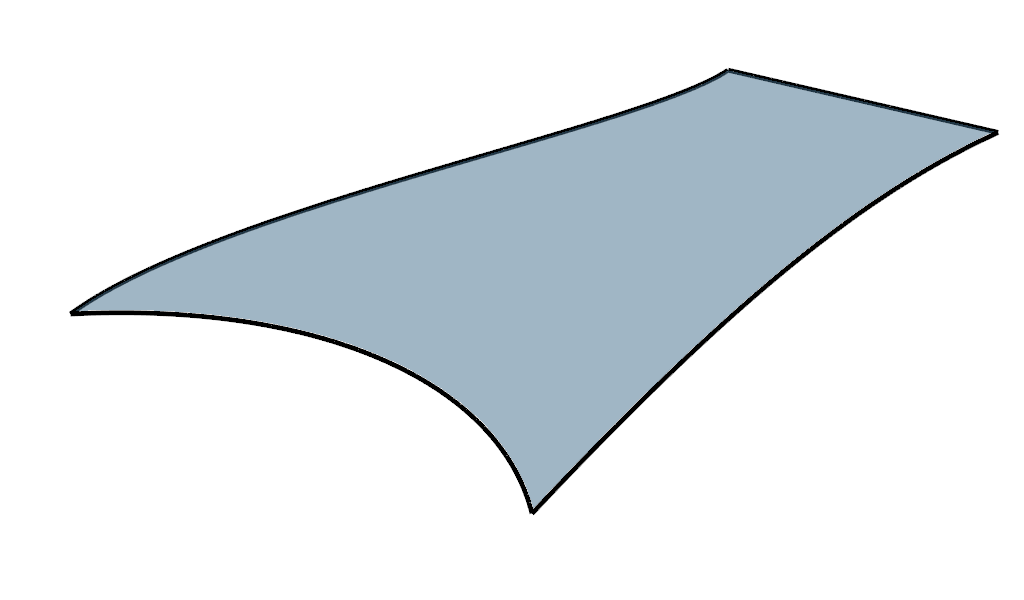
Fill surface from four curve boundaries
Warning
While this method works for non-planar sets of boundary curves, the primary intended use is for co-planar boundary curves. Undesirable surface shapes may result if using non-planar curves.
- Parameters:
left_curve (BezierCurve3D or RationalBezierCurve3D) – Left boundary curve
right_curve (Bezier3D or RationalBezierCurve3D) – Right boundary curve
top_curve (Bezier3D or RationalBezierCurve3D) – Top boundary curve
bottom_curve (Bezier3D or RationalBezierCurve3D) – Bottom boundary curve
displacement_degree (int) – Degree of function used to displace the surface control points to accommodate the top and bottom surfaces. Default: 3
- Returns:
Fill surface
- Return type:
- classmethod from_bezier_revolve(bezier: BezierCurve3D, axis: Line3D, start_angle: Angle, end_angle: Angle)[source]#
Creates a rational Bézier surface from the revolution of a Bézier curve about an axis.
- Parameters:
bezier (BezierCurve3D) – Bézier curve to revolve
axis (Line3D) – Axis of revolution
start_angle (Angle) – Starting angle for the revolve
end_angle (Angle) – Ending angle for the revolve
- Returns:
Surface of revolution
- Return type:
- generate_control_point_net()[source]#
Generates a list of
Point3DandLine3Dobjects representing the rational Bézier surface’s control points and connections between them
- get_control_point_array() ndarray[source]#
Converts the nested list of control points to a 3-D
ndarray.- Returns:
3-D array
- Return type:
- get_corner_index(surface_corner: ~aerocaps.geom.surfaces.SurfaceCorner) -> (<class 'int'>, <class 'int'>)[source]#
Gets the \(i\)- and \(j\)-indices of the control point corresponding to the input corner
- Parameters:
surface_corner (SurfaceCorner) – Corner from which to retrieve the index
- Returns:
\(i\)-index and \(j\)-index, respectively
- Return type:
- get_edge(edge: SurfaceEdge, n_points: int = 10) ndarray[source]#
Evaluates the surface at
n_pointsparameter locations along a given edge.- Parameters:
edge (SurfaceEdge) – Edge along which to evaluate
n_points (int) – Number of evenly-spaced parameter locations at which to evaluate the edge curve. Default: 10
- Returns:
2-D array of size \(n_\text{points} \times 3\)
- Return type:
- get_first_deriv_cp_sens_along_edge(edge: SurfaceEdge, i: int, j: int, n_points: int = 10, perp: bool = True) ndarray[source]#
Gets the sensitivity of the first \(u\)- or \(v\)-derivative along an edge with respect to control point \(\mathbf{P}_{i,j}\)
- Parameters:
edge (SurfaceEdge) – Edge along which to evaluate
i (int) – \(i\)-index of the control point
j (int) – \(j\)-index of the control point
n_points (int) – Number of evenly-spaced parameter locations at which to evaluate the derivative. Default: 10
perp (bool) – Whether to evaluate the cross-derivative. If
False, the derivative along the parameter direction parallel to the edge will be evaluated instead. Default:True
- Returns:
2-D array of size \(n_\text{points} \times 3\)
- Return type:
- get_first_derivs_along_edge(edge: SurfaceEdge, n_points: int = 10, perp: bool = True) ndarray[source]#
Evaluates the parallel or perpendicular derivative along a surface edge at
n_pointsparameter locations. The derivative represents either \(\frac{\partial \mathbf{S}(u,v)}{\partial u}\) or \(\frac{\partial \mathbf{S}(u,v)}{\partial v}\) depending on which edge is selected and which value is assigned toperp.- Parameters:
edge (SurfaceEdge) – Edge along which to evaluate
n_points (int) – Number of evenly-spaced parameter locations at which to evaluate the derivative. Default: 10
perp (bool) – Whether to evaluate the cross-derivative. If
False, the derivative along the parameter direction parallel to the edge will be evaluated instead. Default:True
- Returns:
2-D array of size \(n_\text{points} \times 3\)
- Return type:
- get_homogeneous_control_points() ndarray[source]#
Gets the array of control points in homogeneous coordinates, \(\mathbf{P}_{i,j} \cdot w_{i,j}\)
- Returns:
Array of size \((n + 1) \times (m + 1) \times 4\), where \(n\) is the surface degree in the \(u\)-direction and \(m\) is the surface degree in the \(v\)-direction. The four elements of the last array dimension are, in order, the \(x\)-coordinate, \(y\)-coordinate, \(z\)-coordinate, and weight of each control point.
- Return type:
- get_parallel_degree(surface_edge: SurfaceEdge)[source]#
Gets the degree of the curve corresponding to the input surface edge.
- Parameters:
surface_edge (SurfaceEdge) – Edge along which the parallel degree is evaluated
- Returns:
Degree parallel to the edge
- Return type:
- get_parallel_n_points(surface_edge: SurfaceEdge) int[source]#
Gets the number of control points in the parametric direction parallel to the input surface edge.
- Parameters:
surface_edge (SurfaceEdge) – Edge along which the parallel number of control points is evaluated
- Returns:
Number of control points parallel to the edge
- Return type:
- get_perpendicular_degree(surface_edge: SurfaceEdge)[source]#
Gets the degree of the curve in the parametric direction perpendicular to the input surface edge.
- Parameters:
surface_edge (SurfaceEdge) – Edge along which the perpendicular degree is evaluated
- Returns:
Degree perpendicular to the edge
- Return type:
- get_perpendicular_n_points(surface_edge: SurfaceEdge) int[source]#
Gets the number of control points in the parametric direction perpendicular to the input surface edge.
- Parameters:
surface_edge (SurfaceEdge) – Edge along which the perpendicular number of control points is evaluated
- Returns:
Number of control points perpendicular to the edge
- Return type:
- get_point(row_index: int, continuity_index: int, surface_edge: SurfaceEdge)[source]#
Gets the point corresponding to a particular index along the edge curve with perpendicular index corresponding to the level of continuity being applied. For example, for a \(6 \times 5\) rational Bézier surface, the following code
p = surf.get_point(2, 1, ac.SurfaceEdge.v0)
returns the point \(\mathbf{P}_{2,1}\) and
p = surf.get_point(2, 1, ac.SurfaceEdge.u1)
returns the point \(\mathbf{P}_{6-1,2} = \mathbf{P}_{5,2}\).
See also
set_pointSetter equivalent of this method
- Parameters:
row_index (int) – Index along the surface edge control points
continuity_index (int) – Index in the parametric direction perpendicular to the surface edge. Normally either
0,1, or2surface_edge (SurfaceEdge) – Edge of the surface along which to retrieve the control point
- Returns:
Point used to enforce \(G^x\) continuity, where \(x\) is the value of
continuity_index- Return type:
- get_point_ij(row_index: int, continuity_index: int, surface_edge: ~aerocaps.geom.surfaces.SurfaceEdge) -> (<class 'int'>, <class 'int'>)[source]#
Gets the point indices corresponding to a particular index along the edge curve with perpendicular index corresponding to the level of continuity being applied.
- Parameters:
row_index (int) – Index along the surface edge control points
continuity_index (int) – Index in the parametric direction perpendicular to the surface edge. Normally either
0,1, or2surface_edge (SurfaceEdge) – Edge of the surface along which to retrieve the control point
- Returns:
Point indices used to enforce \(G^x\) continuity, where \(x\) is the value of
continuity_index- Return type:
- get_second_deriv_cp_sens_along_edge(edge: SurfaceEdge, i: int, j: int, n_points: int = 10, perp: bool = True) ndarray[source]#
Gets the sensitivity of the second \(u\)- or \(v\)-derivative along an edge with respect to control point \(\mathbf{P}_{i,j}\)
- Parameters:
edge (SurfaceEdge) – Edge along which to evaluate
i (int) – \(i\)-index of the control point
j (int) – \(j\)-index of the control point
n_points (int) – Number of evenly-spaced parameter locations at which to evaluate the derivative. Default: 10
perp (bool) – Whether to evaluate the cross-derivative. If
False, the derivative along the parameter direction parallel to the edge will be evaluated instead. Default:True
- Returns:
2-D array of size \(n_\text{points} \times 3\)
- Return type:
- get_second_derivs_along_edge(edge: SurfaceEdge, n_points: int = 10, perp: bool = True) ndarray[source]#
Evaluates the parallel or perpendicular second derivative along a surface edge at
n_pointsparameter locations. The derivative represents either \(\frac{\partial^2 \mathbf{S}(u,v)}{\partial u^2}\) or \(\frac{\partial^2 \mathbf{S}(u,v)}{\partial v^2}\) depending on which edge is selected and which value is assigned toperp.- Parameters:
edge (SurfaceEdge) – Edge along which to evaluate
n_points (int) – Number of evenly-spaced parameter locations at which to evaluate the second derivative. Default: 10
perp (bool) – Whether to evaluate the cross-derivative. If
False, the second derivative along the parameter direction parallel to the edge will be evaluated instead. Default:True
- Returns:
2-D array of size \(n_\text{points} \times 3\)
- Return type:
- get_u_or_v_given_uvxyz(u: float = None, v: float = None, uv_guess: float = 0.5, x: Length = None, y: Length = None, z: Length = None)[source]#
Computes one parametric value given the other and a specified \(x\)-, \(y\)-, or \(z\)-location. As an example, given a
RationalBezierSurfaceobject assigned to the variablesurf, the \(u\)-parameter corresponding to \(y=1.4\) along the \(v=0.8\) isoparametric curve can be computed usingu = surf.get_u_or_v_given_uvxyz(v=0.8, y=1.4)
Note that the inputs are keyword arguments to avoid having to specify
Nonefor each of the arguments not used.- Parameters:
u (float or None) – Value of \(u\) to solve for or specify. If left as
None, this parameter will be solved for. IfNone, \(v\) must be specified. Default:Nonev (float or None) – Value of \(v\) to solve for or specify. If left as
None, this parameter will be solved for. IfNone, \(u\) must be specified. Default:Noneuv_guess (float) – Starting guess for the unsolved \(u\) or \(v\) parameter. Default:
0.5x (Length or None) – \(x\)-location corresponding to the \(u\) or \(v\) parameter to be solved. If this value is outside the surface geometry, the root-finder will fail and an error will be raised. If unspecified, either \(y\) or \(z\) must be specified. Default:
Noney (Length or None) – \(y\)-location corresponding to the \(u\) or \(v\) parameter to be solved. If this value is outside the surface geometry, the root-finder will fail and an error will be raised. If unspecified, either \(x\) or \(z\) must be specified. Default:
Nonez (Length or None) – \(z\)-location corresponding to the \(u\) or \(v\) parameter to be solved. If this value is outside the surface geometry, the root-finder will fail and an error will be raised. If unspecified, either \(x\) or \(y\) must be specified. Default:
None
- Returns:
The value of \(u\) if \(v\) is specified or \(v\) if \(u\) is specified
- Return type:
- get_weight(row_index: int, continuity_index: int, surface_edge: SurfaceEdge) float[source]#
Gets the weight corresponding to a particular index along the edge curve with perpendicular index corresponding to the level of continuity being applied. For example, for a \(6 \times 5\) rational Bézier surface, the following code
w = surf.get_weight(2, 1, ac.SurfaceEdge.v0)
returns the weight \(w_{2,1}\) and
w = surf.get_weight(2, 1, ac.SurfaceEdge.u1)
returns the weight \(w_{6-1,2} = w_{5,2}\).
See also
set_weightSetter equivalent of this method
- Parameters:
row_index (int) – Index along the surface edge weights
continuity_index (int) – Index in the parametric direction perpendicular to the surface edge. Normally either
0,1, or2surface_edge (SurfaceEdge) – Edge of the surface along which to retrieve the weight
- Returns:
Weight used to enforce \(G^x\) continuity, where \(x\) is the value of
continuity_index- Return type:
- property m: int#
Shorthand for
degree_v- Returns:
Surface degree in the \(v\)-parametric direction
- Return type:
- property n: int#
Shorthand for
degree_u- Returns:
Surface degree in the \(u\)-parametric direction
- Return type:
- plot_control_point_mesh_lines(plot: Plotter, **line_kwargs) Actor[source]#
Plots the network of lines connecting the rational Bézier surface control points using the pyvista library
- Parameters:
plot –
pyvista.Plotterinstanceline_kwargs – Keyword arguments to pass to the
pyvista.Plotter.add_lines
- Returns:
The lines actor
- Return type:
pv.Actor
- plot_control_points(plot: Plotter, **point_kwargs) Actor[source]#
Plots the rational Bézier surface control points using the pyvista library
- Parameters:
plot –
pyvista.Plotterinstancepoint_kwargs – Keyword arguments to pass to the
pyvista.Plotter.add_points
- Returns:
The points actor
- Return type:
pv.Actor
- plot_surface(plot: Plotter, Nu: int = 50, Nv: int = 50, **mesh_kwargs)[source]#
Plots the rational Bézier surface using the pyvista library
- Parameters:
plot –
pyvista.PlotterinstanceNu (int) – Number of points to evaluate in the \(u\)-parametric direction. Default:
50Nv (int) – Number of points to evaluate in the \(v\)-parametric direction. Default:
50mesh_kwargs – Keyword arguments to pass to
pyvista.Plotter.add_mesh
- Returns:
The evaluated rational Bézier surface
- Return type:
- static project_homogeneous_control_points(homogeneous_points: ~numpy.ndarray) -> (<class 'numpy.ndarray'>, <class 'numpy.ndarray'>)[source]#
Projects the homogeneous coordinates onto the \(w=1\) hyperplane.
- Returns:
The projected coordinates in three-dimensional space followed by the weight array
- Return type:
- reverse_u() RationalBezierSurface[source]#
Reverses the surface in the \(u\)-direction
- reverse_v() RationalBezierSurface[source]#
Reverses the surface in the \(v\)-direction
- set_point(point: Point3D, row_index: int, continuity_index: int, surface_edge: SurfaceEdge)[source]#
Sets the point corresponding to a particular index along the edge curve with perpendicular index corresponding to the level of continuity being applied. For example, for a \(6 \times 5\) rational Bézier surface, the following code
p = ac.Point3D.from_array(np.array([3.0, 4.0, 5.0]))
surf.set_point(p, 2, 1, ac.SurfaceEdge.v0)
sets the value of point \(\mathbf{P}_{2,1}\) to \([3,4,5]^T\) and
p = ac.Point3D.from_array(np.array([3.0, 4.0, 5.0]))
surf.set_point(p, 2, 1, ac.SurfaceEdge.u1)
sets the value of point \(\mathbf{P}_{6-1,2} = \mathbf{P}_{5,2}\) to \([3,4,5]^T\).
See also
get_pointGetter equivalent of this method
- Parameters:
point (Point3D) – Point object to apply at the specified indices
row_index (int) – Index along the surface edge control points
continuity_index (int) – Index in the parametric direction perpendicular to the surface edge. Normally either
0,1, or2surface_edge (SurfaceEdge) – Edge of the surface along which to retrieve the control point
- set_weight(weight: float, row_index: int, continuity_index: int, surface_edge: SurfaceEdge)[source]#
Sets the weight corresponding to a particular index along the edge curve with perpendicular index corresponding to the level of continuity being applied. For example, for a \(6 \times 5\) rational Bézier surface, the following code
surf.set_weight(0.9, 2, 1, ac.SurfaceEdge.v0)
sets the value of weight \(w_{2,1}\) to \(0.9\) and
surf.set_weight(1.1, 2, 1, ac.SurfaceEdge.u1)
sets the value of weight \(w_{6-1,2} = w_{5,2}\) to \(1.1\).
See also
get_weightGetter equivalent of this method
- Parameters:
weight (float) – Weight to apply at the specified indices
row_index (int) – Index along the surface edge weights
continuity_index (int) – Index in the parametric direction perpendicular to the surface edge. Normally either
0,1, or2surface_edge (SurfaceEdge) – Edge of the surface along which to retrieve the weight
- split_at_u(u0: float)[source]#
Splits the rational Bezier surface at \(u=u_0\) along the \(v\)-parametric direction.
- split_at_v(v0: float)[source]#
Splits the rational Bezier surface at \(v=v_0\) along the \(u\)-parametric direction.
- to_iges(*args, **kwargs) IGESEntity[source]#
Converts the geometric object to an IGES entity. To add this IGES entity to an
.igsfile, use anIGESGenerator.
- transform(**transformation_kwargs) RationalBezierSurface[source]#
Creates a transformed copy of the surface by transforming each of the control points
- Parameters:
transformation_kwargs – Keyword arguments passed to
Transformation3D- Returns:
Transformed surface
- Return type:
- verify_g0(other: RationalBezierSurface, surface_edge: SurfaceEdge, other_surface_edge: SurfaceEdge, n_points: int = 10)[source]#
Verifies that two RationalBezierSurfaces are G0 continuous along their shared edge
- verify_g1(other: RationalBezierSurface, surface_edge: SurfaceEdge, other_surface_edge: SurfaceEdge, n_points: int = 10)[source]#
Verifies that two RationalBezierSurfaces are G1 continuous along their shared edge
- verify_g2(other: RationalBezierSurface, surface_edge: SurfaceEdge, other_surface_edge: SurfaceEdge, n_points: int = 10)[source]#
Verifies that two RationalBezierSurfaces are G2 continuous along their shared edge